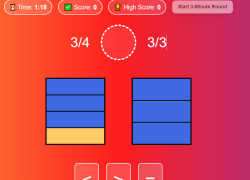
Students build visual understanding of fraction size by comparing them using interactive models. They decide less than, greater than, or equal in a timed, engaging challenge.
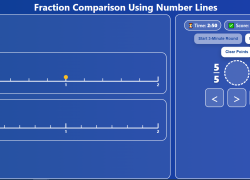
Students will plot proper, improper, and mixed fractions on number lines. They then compare magnitude using , or = to build strong fraction sense and understand benchmarks.
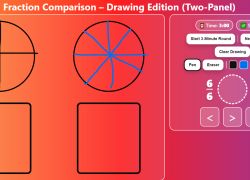
Students actively compare fractions using drawing and visual models. They decide if fractions are less than, greater than, or equal, building strong fraction sense.
Engage students with a fast-paced game to master number patterns, sequences, and tables. They will develop fluency, speed, and strategic thinking under pressure.
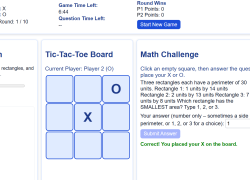
Your students will strengthen their understanding of area and perimeter by solving varied problems in an interactive tic-tac-toe game. They'll practice finding missing dimensions and comparing rectangles.
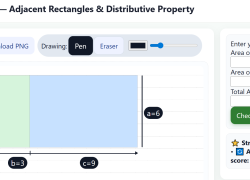
Students explore area concepts with an interactive tool. They calculate and combine adjacent rectangle areas to find total shapes, reinforcing multiplication and the distributive property.
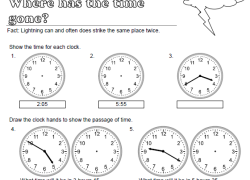
Students in 3rd grade will reinforce telling time skills and solve four elapsed time word problems. They will use visible clocks to help calculate the duration of events.
Challenge students to design an Earth Science experiment. They will determine which sediment type exhibits the greatest porosity and permeability through hands-on investigation.
Discover how rivers curve and change shape. Students will learn core concepts of erosion, deposition, and stream formation, understanding various river landforms.
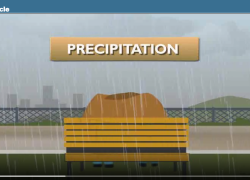
Students will learn about the water cycle, including key terms like precipitation, evaporation, and condensation. This video explains how water moves and transforms through Earth's atmosphere.