Relative Dating Lab for Earth Science
In this student self-guided Earth Science activity, students will read about and work their way through the different techniques used in Relative Dating.
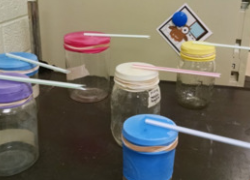
In this Earth Science Lab, students will gain an understanding of what relative humidity and dew point are. There are four parts to the lab. The first part will help them understand the relationship between the ability to evaporate and humidity. Students will then use psychrometers to determine the humidity outside as well as inside. They will calculate the wet-bulb depression and then use the relative humidity chart to determine the percent of water in the air outside and inside the classroom.
Students will research 8 common metamorphic rocks. Marble, quartzite, hornfels, slate, phyllite, schist, gneiss, and amphibolite. Students will have a better understanding of what foliated vs. non-foliated rocks look like. They will understand what a parent rock is and review some of their mineral knowledge by researching what some of the most dominant minerals are in these particular metamorphic rocks. Finally, when they are done they will discuss with their groups some higher-order thinking questions that will drive the class discussion when the assignment is completed.
In this activity students are going to find a small rock, decide what rock type it is, weight it, place it in a tumbler and then over a two week period observe it to see how much mass a rock can lose if it went through a 24 hour a day process of bouncing around other rocks. Students will get a first-hand look at the power behind water and abrasion. Students will make a statement of conclusion and calculate the rate of mass decrease.
For more Earth Science labs and resources visit EarthScience.xyz
A third-grade worksheet designed to reinforce rounding numbers to the nearest 10 and nearest 100. It included 3 word problems, 4 questions using a number line, and a mix of rounding to 10s and 100s.
This is a worksheet I use with my students when they are reading in the scholastic news. It is designed to reinforce some of the reading standards that they need to know.
Students will find this grammar activity and worksheet fun as they try to put the words in the correct order to make a sentence.
This is an animated video discussing the age of the earth. It discusses uranium and zirconium dating methods. Part of the video also talks about how geologists use relative age dating.
This is a great video that can be used to introduce or review the main ideas and supporting details in a story or paragraph.
In this activity, students will hone their observation, inference, and making conclusions skill by trying their best to use a dichotomous classification key to determine the name of their rocks. This Earth Science lab also contains a dichotomous key used for teaching students how sedimentary rocks are classified.
Find more Earth Science lessons and labs at EarthScience.xyz.
Other rock and mineral identification labs can be found at: