Help students visualize the incredible, tiny scale of atoms. They will learn about atomic size through compelling comparisons, enhancing their grasp of fundamental atomic structure concepts.
Students will investigate the heart's intricate mechanics, understanding how it efficiently circulates blood. They will explore the vital function of the ventricle system.
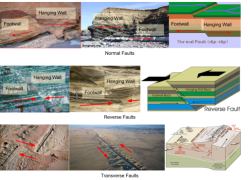
Students will use Google Drawing to create diagrams of earthquake fault types. They will identify real-world examples, apply forces like shear and tension, and label key geological structures.
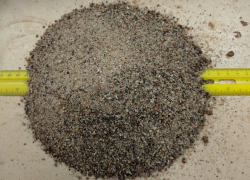
Students determine the angle of repose for sand, observing how slope impacts stability. They will compare trials, apply math skills, and analyze observations about erosion and landslides.
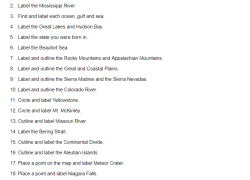
Guide students as they learn to identify, label, and map 25 major landforms spanning North and South America. An optional presentation enhances their geological understanding.
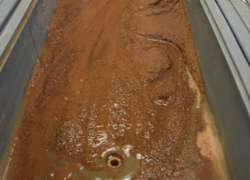
Students use stream tables to observe how rivers develop. They will explore how landslides change river courses, meanders, sediment deposition, river paths, and delta formation.
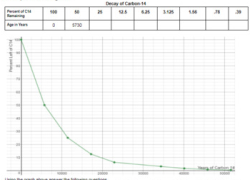
Students model absolute dating and half-life with candy. Graph Carbon-14 decay, solve problems, and apply probability to date rocks and fossils.
Students will actively observe Earth's plate tectonics with a simple chocolate demonstration. They'll witness crust break apart, magma rise, and understand earthquakes and igneous rock formation.
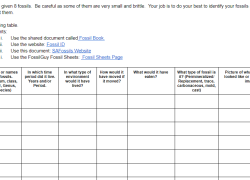
Students will identify various fossil types using provided links, researching their formation, ancient environments, and geologic time. They will also explore the significance of paleontological study.
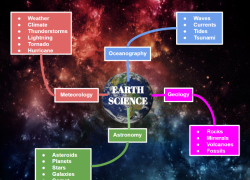
Students develop an Earth Science concept map in Google Drawing, connecting terms from geology, astronomy, and meteorology. They'll organize core concepts and use a collaborative tool. Rubric included.
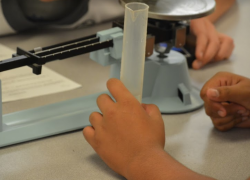
Students design and conduct an experiment to determine the densities of various rocks and minerals. They will apply scientific inquiry to calculate mass, volume, and density.
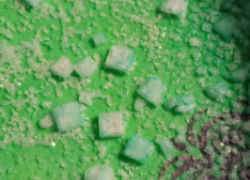
Students observe crystal formation and explore how impurities change mineral color in this Earth Science lab. Perfect for grades 3-10, it includes student work and sample results.