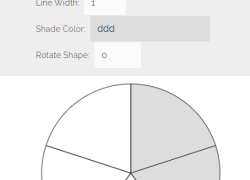
Create custom visuals of fractional parts using circles and polygons. Students will visualize and better understand parts of a whole in your lessons and assignments.
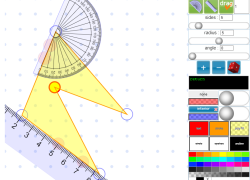
Students actively explore polygons and quadrilaterals, manipulating shape properties and angles. They learn about interior/exterior angles and virtually practice using protractors and rulers.
Engage students in a compelling discussion on scientific experimentation. Learners analyze three studies demonstrating how focused thought can influence actions and real-world outcomes.
Help students understand energy concepts with this quick video. They will learn about chemical, nuclear, and dark energy, gaining foundational knowledge easily.
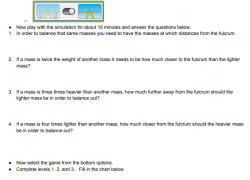
Your students will explore lever balancing in a Phet simulation. They investigate mass and distance relationships from the fulcrum and calculate mechanical advantage.
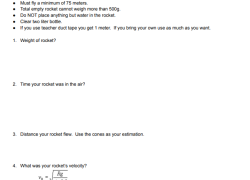
Guide students through building and launching water rockets. They'll apply physics, perform calculations, and analyze flight data over two launches, improving designs to maximize distance.
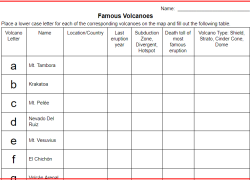
Students research 14 notable volcanoes, mapping locations, identifying plate boundaries, and classifying volcano types. They will explore eruption histories and geographical impacts.
Students will learn Earth's crust, mantle, and core, plus convection and Pangaea. An engaging, animated song and video help them visualize these fascinating concepts.
Students explore Earth's layers, scientific discovery methods, and concepts like convection currents and density. They will understand how layers work together to form our planet.
Students will understand why temperatures rise underground, exploring Earth's layers, convection, volcanoes, and plate tectonics. Discover Lord Kelvin's methods for dating Earth.
Students will discover how supervolcano eruptions, like Mt. Tambora, triggered global climate crises and the devastating 1816 Year without a Summer.
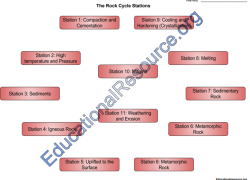
Students will roll dice and follow instructions to create unique rock cycle paths. This hands-on activity builds appreciation for Earth's diverse rock formations and their individual stories.