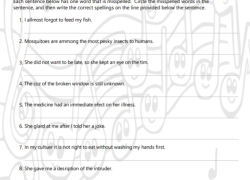
Challenge students to locate and correct misspelled vocabulary words within sentences. They will rewrite each sentence correctly, strengthening their spelling and editing skills.
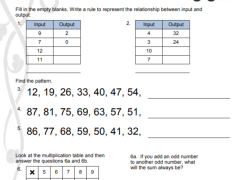
Students will identify numbered patterns, exploring input-output tables. They will practice addition, subtraction, and a multiplication pattern, developing critical thinking skills.
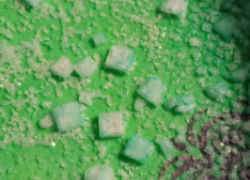
Students observe crystal formation and explore how impurities change mineral color in this Earth Science lab. Perfect for grades 3-10, it includes student work and sample results.
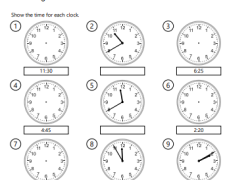
Students will master reading time by analyzing clock faces and drawing hands for digital displays. Includes a bonus multiplication review word problem.
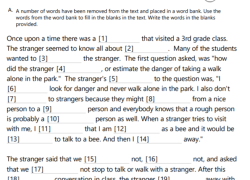
Engage 3rd graders with a cloze activity on stranger awareness. Students will fill 19 missing words from a list, enhancing reading comprehension, vocabulary, and safety knowledge.
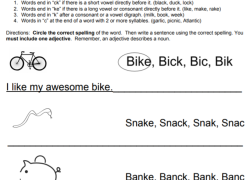
Help students master the phonics rule for words ending in ck, k, c, or ke. They will identify correct spellings and use them in their own sentences.
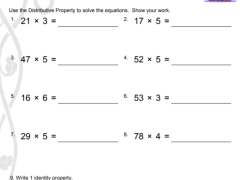
Engage elementary students with distributive property practice, finding products. They will also review identity, zero, commutative, and associative properties, solidifying foundational math understanding.
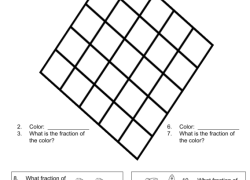
Students design colorful 5x5 grid patterns, then determine fractions for each color. They also practice finding fractions from animal and flying machine groups, building fraction mastery.
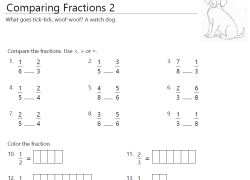
Help 3rd graders compare fractions using , and =. Students will visualize and order fractions using bars and a number line, including those with different denominators.
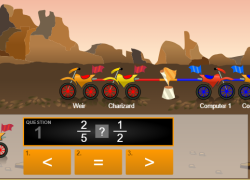
Students learn to assess fractional values in an engaging multiplayer tug-of-war game. They compete globally, building strong fraction skills and strategic thinking.
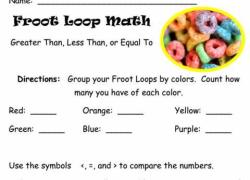
Engage students with a tasty math challenge! They count, sort, and compare quantities of colorful Fruit Loops, developing essential number comparison abilities through playful exploration.
Students will explore an animated comparison illustrating the vast scale differences between cells, bacteria, viruses, and cellular parts. Enhance their understanding of microscopic dimensions.