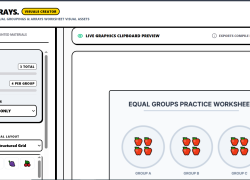
Help students connect multiplication, division, and repeated addition using printable visual models like equal groups, arrays, and number lines.
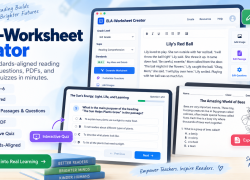
Students in grades 1-6 will master ELA skills. Easily generate custom reading passages and questions to practice comprehension, analyze texts, and build vocabulary effortlessly.
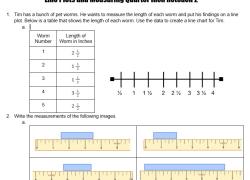
Students will measure objects to the quarter inch, record data, and create accurate line plots. They will analyze real-world scenarios to strengthen their 3rd-grade measurement and data analysis skills.
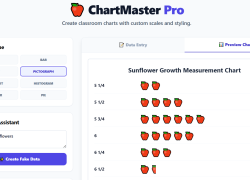
Easily create custom classroom charts. Students will analyze data, interpret graphs, and develop essential graphing skills across subjects like math, science, and social studies.
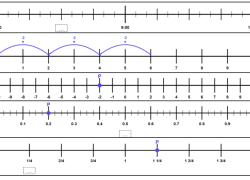
Students will explore integers, fractions, decimals, and elapsed time using custom number lines. They will visually master number sense and operations across various math topics.
Help students master cellular biology terms through an interactive vocabulary quest. They will identify and learn 18 essential cell structures with digital or printable activities.
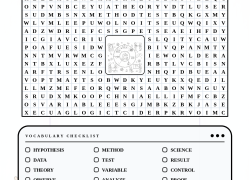
Students will master essential scientific method vocabulary, including Hypothesis and Experiment, using engaging digital and printable activities. They'll build scientific literacy and critical visual skills.
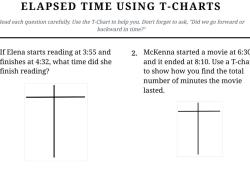
Students will learn a structured method for elapsed time using T-charts. They'll practice finding start, end, and duration, improving their time-telling abilities.
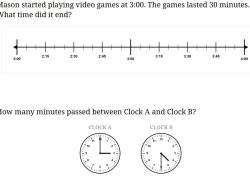
Help students master elapsed time using number lines and analog clocks. They solve real-life problems by moving forward and backward in time, building deep understanding.
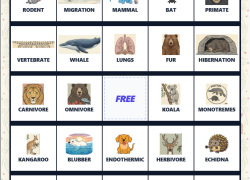
Students will review and reinforce key mammal characteristics and classification. They identify traits like warm-blooded, fur, and lungs, expanding science vocabulary through an engaging, interactive game.