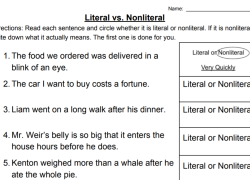
Help 3rd graders practice distinguishing between literal and nonliteral language. Students will interpret figurative sentences, explaining their true meaning and identifying different language uses.
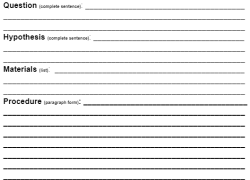
Students engage with the scientific method, honing grammar skills. They practice writing complete sentences to document experiment observations and insightful conclusions effectively.
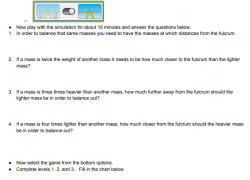
Your students will explore lever balancing in a Phet simulation. They investigate mass and distance relationships from the fulcrum and calculate mechanical advantage.
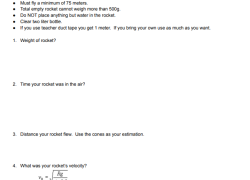
Guide students through building and launching water rockets. They'll apply physics, perform calculations, and analyze flight data over two launches, improving designs to maximize distance.
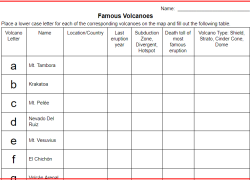
Students research 14 notable volcanoes, mapping locations, identifying plate boundaries, and classifying volcano types. They will explore eruption histories and geographical impacts.
Students analyze two texts on school uniform benefits and drawbacks. They will then craft an evidence-based opinion piece, strengthening critical thinking and persuasive writing skills.
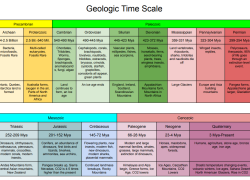
Guide students to explore Earth's geologic history from Precambrian to Cenozoic. They will learn about ancient creatures and landforms through a captivating, color-coded visual timeline.
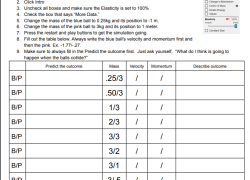
Students investigate collision and momentum through a digital simulation. They make predictions, analyze results, and deepen understanding of elastic/inelastic collisions, velocities, and data analysis.
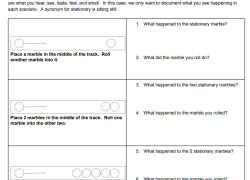
Students will conduct hands-on experiments, exploring motion and collision principles. They'll investigate how size and mass impact interactions, connecting lab discoveries to practical, real-life physics.
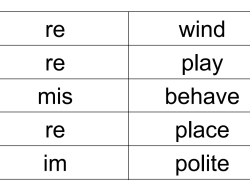
Students actively match prefixes to root words in a fun, timed game. They build vocabulary and strengthen understanding of how prefixes change word meaning.
Collect essential student details from parents to better meet individual learning needs. Students will receive tailored support and benefit from a more informed classroom approach.
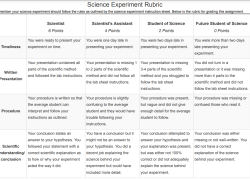
Help students understand expectations for their science experiment presentations. Grade their scientific inquiry, data interpretation, and communication effectively with clear criteria.