Students dive into estimating water volume in diverse containers. They measure with graduated cylinders, then compare their predictions to actual amounts for engaging learning.

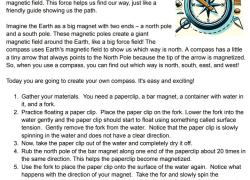
Students will read to understand Earth's magnetic field, then build their own compass. They will grasp magnetic principles and how a compass functions through a hands-on, engaging experiment.
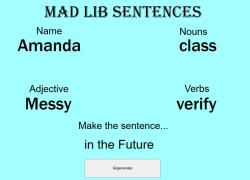
Students generate creative sentences using random names, nouns, adjectives, and verbs. They practice grammar, expand vocabulary, and incorporate elements like setting, emotion, or figurative language.
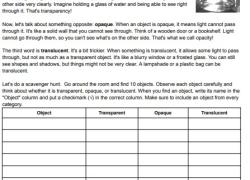
Engage students with a reading passage exploring transparent, opaque, and translucent properties. They will categorize objects during an interactive scavenger hunt, developing observation skills.
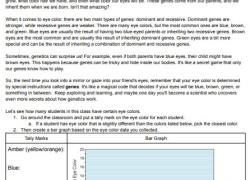
Students explore genetics, discovering how genes determine eye color. They'll collect classroom data, create a bar graph, and understand dominant and recessive inheritance patterns.
Students learn about the sun's heat energy transfer through radiation. They will investigate how colors affect heat absorption with a reading passage and an interactive lab experiment.
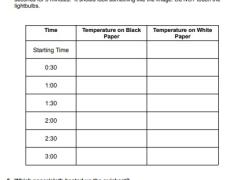
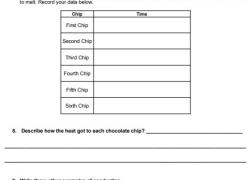
Students will learn about heat transfer through conduction. They will conduct an experiment, observe heat traveling, and identify real-life examples, deepening their understanding of scientific principles.
Students will explore the fundamental attraction of atoms, discovering their basic structure. They will learn about covalent and ionic bonding, understanding why atoms form molecular connections.
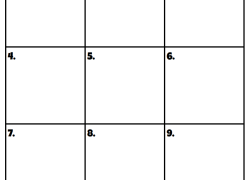
Provide students with ample space to solve math problems during assessments. Numbered boxes help them organize work and track questions, promoting clarity and focus.
Help students grasp the immense scale of the universe. They will compare celestial object sizes and distances, developing strong spatial reasoning and understanding their place within the cosmos.
Engage students with a powerful narration of the Declaration of Independence performed by acclaimed Hollywood actors. Foster a deeper understanding of this foundational American document.
Students uncover why certain objects *feel* colder than others, even at the same temperature. They observe and predict heat transfer in materials, including a compelling ice-melting experiment demonstrating thermal condu