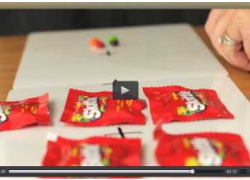
Students discover additive properties, including commutative and associative, by manipulating Skittles. They will master combining like terms, simplifying expressions, and creating equivalent expressions.
Engage third graders with a timed game! Students identify author's purpose (PIE) by analyzing passages and reinforce multiplication skills. They will master persuade, inform, and entertain concepts.
Engage students with Bill Nye as they explore the joy of discovery. They will hypothesize, test ideas, and form conclusions, thinking like scientists with captivating visuals.
Students will explore how Alzheimer's disease affects the brain, understanding its impact and the progressive stages of this complex neurological condition.
Introduce cells with an engaging animation! Students will explore diverse cell types, learn their functions, and discuss trivia questions to spark scientific curiosity.
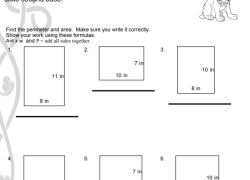
Help 3rd graders master perimeter and area. Students calculate area and perimeter for quadrilaterals, then solve word problems requiring critical thinking and diagramming to find solutions.
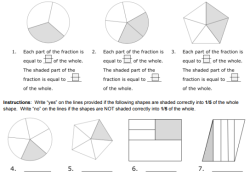
Engage 3rd graders with fractions! Students identify equal parts of shapes, make fractions from shaded sections, and solve word problems reinforcing the meaning of fractional pieces.
Students explore and compare the immense depths of water bodies, from oceans to the Marianas Trench, using an engaging 3D animation. Great for oceanography or plate tectonics.
Students will learn to identify and compare standard liquid volume units including cups, pints, quarts, and gallons. Use this video to build foundational understanding of capacity measurements.
Engage students in a digital exploration of diverse landforms. Students research, document examples, origins, and images of plains, mountains, and plateaus, then share their unique findings.

Engage students with a video exploring why the moon appears larger near the horizon. They will learn about the fascinating optical illusion altering our perception of lunar size.
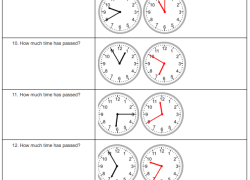
Students will solve various elapsed time problems, including "how much time has passed?" and "what time did it start?". They will gain crucial skills and confidence in time calculations.