Engage students measuring metric distances by propelling pens across the room. They will discover the Magnus Effect and learn to analyze data using spreadsheets with formulas.
Guide students through building and launching water rockets. They'll apply physics, perform calculations, and analyze flight data over two launches, improving designs to maximize distance.
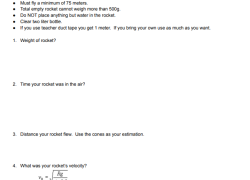
Your students will investigate and compare shoe traction by measuring static friction in this physics experiment. They conduct the lab, analyze data, and draw conclusions on optimal grip.
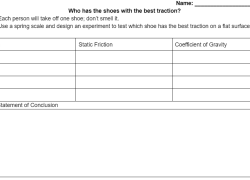
Students will solve engaging problems applying momentum, impulse, force, velocity, and kinetic energy to strengthen physics understanding. An answer key is provided.
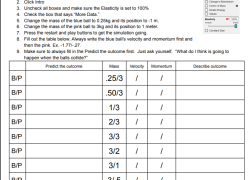
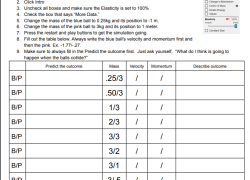
Students investigate collision and momentum through a digital simulation. They make predictions, analyze results, and deepen understanding of elastic/inelastic collisions, velocities, and data analysis.
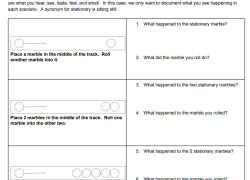
Students will conduct hands-on experiments, exploring motion and collision principles. They'll investigate how size and mass impact interactions, connecting lab discoveries to practical, real-life physics.
Students will analyze the mathematical principles behind levers, discovering how they reduce effort. They'll also explore Archimedes's foundational work and experiments in physics.
Students will discover how air pressure generates wind and learn essential vocabulary. They'll grasp key terms like barometer, convection, and Coriolis Effect, understanding fundamental weather concepts.
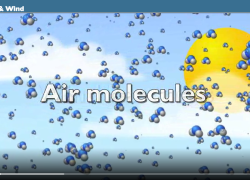
Students learn air pressure basics and discover how heavy air impacts them. This animation clarifies why air's weight doesn't crush us, making complex scientific ideas accessible.
Students will learn essential force and motion concepts like inertia, mass, gravity, friction, Newtons, and energy. This animated explanation deepens their scientific understanding.